Governance & compliance
From requirements to accountable action.
Someone named a framework at you. Reading it is the easy part. Getting each requirement onto a named person, with proof attached, a date on the proof and the gap tracked as work — that is the part spreadsheets quietly stop doing after about six weeks.
No credit card required
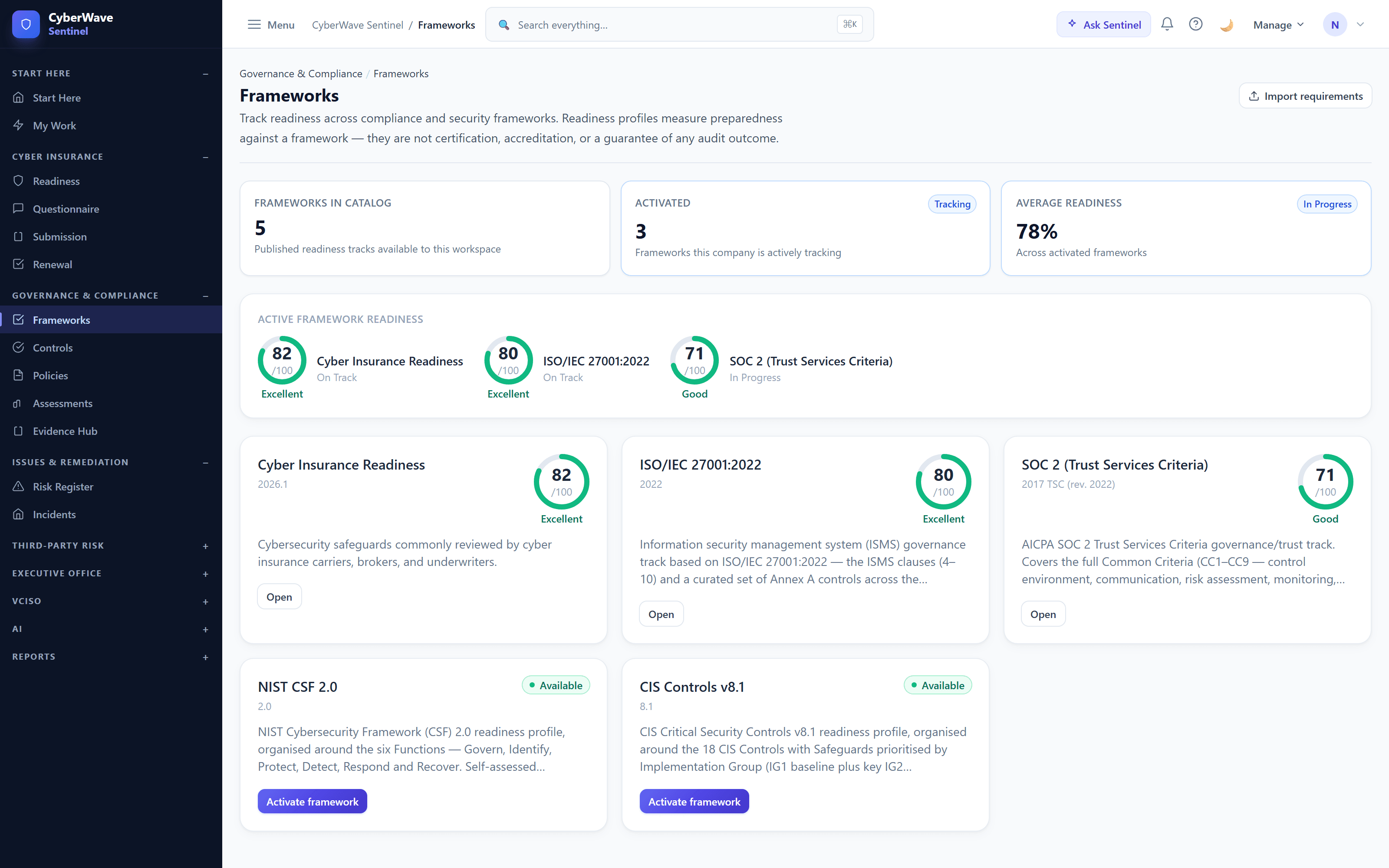
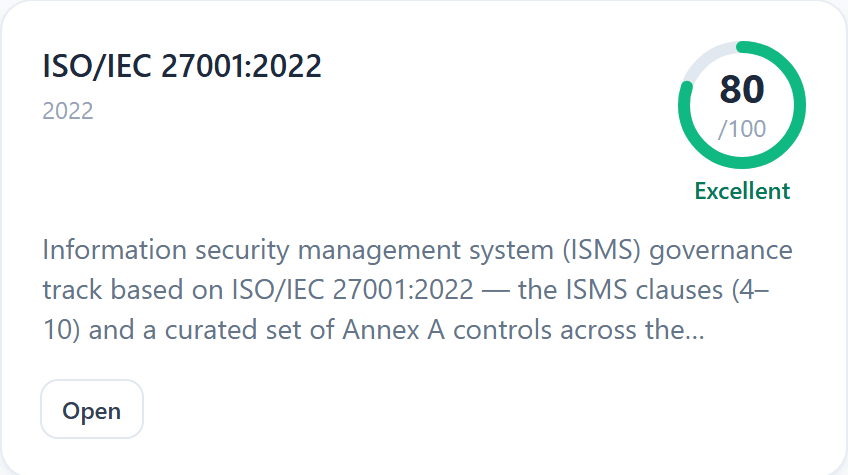
Screens captured from a Sentinel workspace on 10 September 2026. Northstar Manufacturing Ltd. is a fictional example — a 180-person manufacturer in Ontario, Canada — not a customer, and its scores are computed by the product from its records rather than typed in for the picture.
The chain
Eight links, and a programme fails at whichever one is missing.
Read this as a sequence rather than a feature list. Each row consumes what the row above it produced, which is why an unowned control cannot be evidenced and an unevidenced control cannot be reported honestly.
- 01
Requirement
The framework arrives as records you put in scope — 42 controls for ISO/IEC 27001:2022 in Sentinel’s readiness profile — not a PDF you annotate.
- 02
Control
Each requirement becomes a control with a plain description of how it works here. One control usually satisfies several frameworks, which is why the example workspace runs 3 frameworks against 26 controls.
- 03
Owner
A person’s name, not a team and not “IT”. 2 controls in the example workspace are still unassigned, and the register reports that as a gap rather than averaging it away.
- 04
Evidence
Proof attached once, carrying a status and an expiry date. 41 of 46 items accepted and verified; the expired penetration test and the missing restore test are visible before an auditor makes them visible for you.
- 05
Gap
Missing, expired, deficient and unowned are states, not blanks. 2 deficient controls and 1 open finding — a list, not a percentage, because a percentage invites an argument and a list invites work.
- 06
Risk
Where a gap has consequence it is rated likelihood by severity, given a treatment and a target date. 7 open risks in the example register, 1 critical.
- 07
Action
Work with an owner and a due date, bucketed by horizon — Critical Now, Next 30 Days, Next Quarter, Quick Wins, Strategic Projects. 2 critical now and 0 overdue is a sentence somebody can act on this week.
- 08
Report
One readiness view for the executive team, one package for the auditor, one answer for the customer’s security review — generated from the register, with every figure openable to the record it came from.
A control nobody owns is a sentence in a standard.
Certification is an outcome that somebody else awards. Accountability is a property of your register — a name on every control, a date on every piece of proof, and a gap that belongs to somebody. One of those two things you can build this quarter.
In the product
Every requirement lands on a person, with a status.
Open a framework and you are looking at its controls, each with a status — Completed, In progress, Ready for review, Not started — an owner, a due date and the evidence attached. Open a control and you get the plain-English explanation, why it matters, and how to implement it.
The control library underneath keeps its own tabs — Control Library, Framework Readiness, Test Schedule, Test History, Findings — so the test schedule and the findings are part of the register, not a separate spreadsheet. 85% of the example workspace’s controls have been tested; 2 came back deficient.
Control library
26 controls| Control | Owner | Status | Evidence | Last tested |
|---|---|---|---|---|
| A.5.1Policies for information security | Priya Raman | Passed | Accepted | 28 Jul 2026 |
| A.5.18Access rights | Priya Raman | Passed | Accepted | 26 Jun 2026 |
| A.8.5Secure authentication | Priya Raman | Passed | Accepted | 14 Aug 2026 |
| A.8.13Information backup | Jordan Blake | Passed | Accepted | 18 Jun 2026 |
| A.8.2Privileged access rights | Priya Raman | Failed | Needs Review | 20 Aug 2026 |
| A.8.7Protection against malware | Jordan Blake | Tested | Accepted | 28 Aug 2026 |
| CC9.2Vendor and business partner risk management | Elena Kowalski | Failed | Accepted | 12 Aug 2026 |
| PR.AA-01Identities and credentials are managed | Unassigned | Not Tested | Missing | — |
- A.5.1Policies for information security
- Owner
- Priya Raman
- Status
- Passed
- Evidence
- Accepted
- Last tested
- 28 Jul 2026
- A.5.18Access rights
- Owner
- Priya Raman
- Status
- Passed
- Evidence
- Accepted
- Last tested
- 26 Jun 2026
- A.8.5Secure authentication
- Owner
- Priya Raman
- Status
- Passed
- Evidence
- Accepted
- Last tested
- 14 Aug 2026
- + 5 more in the workspace
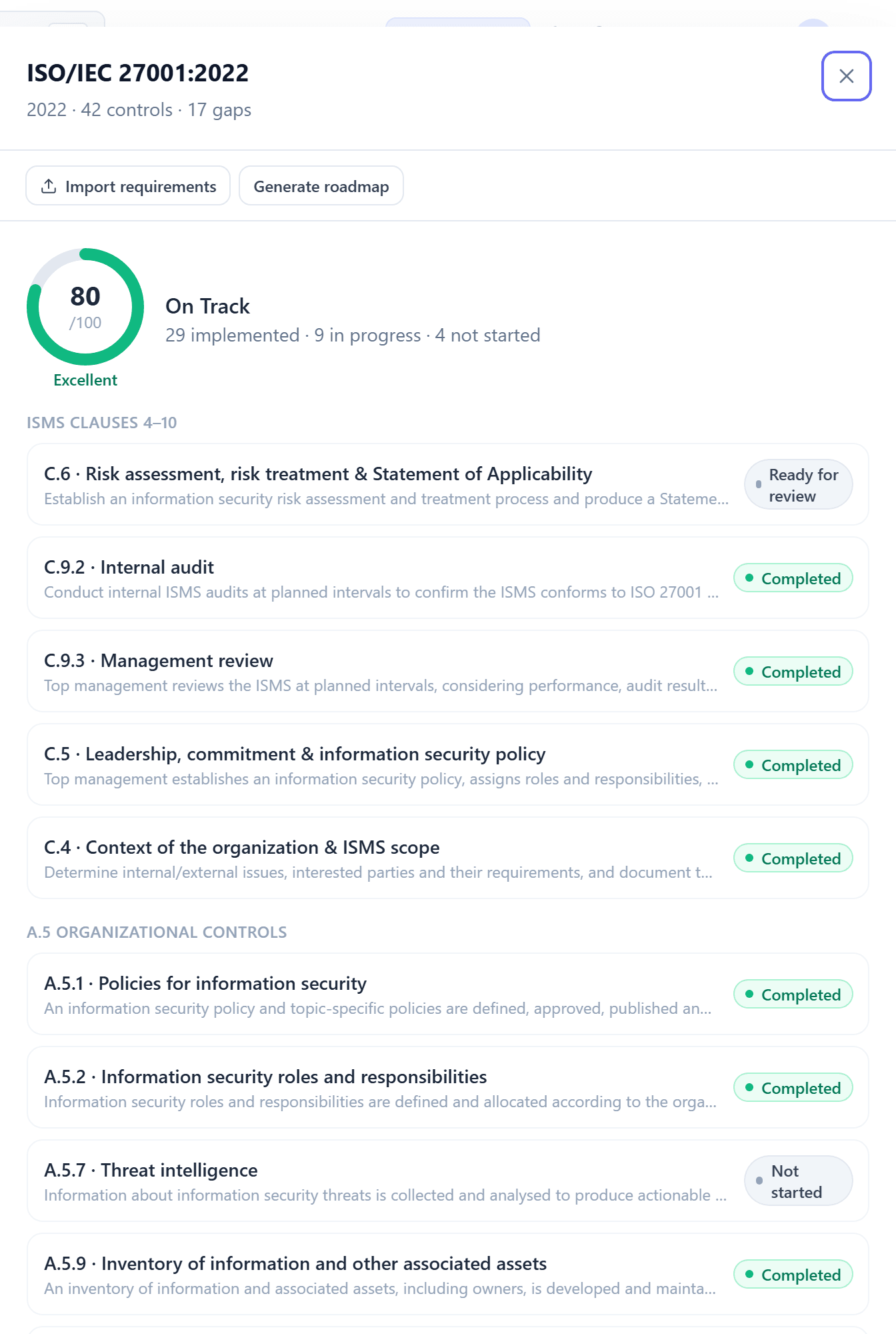
Evidence
Proof with a status and an expiry date.
89% audit readiness in the example workspace: 41 items accepted, 2 awaiting review, 1 expired, 1 missing. Attach a file once with its expiry date, and a lapsed item is flagged in the list before an auditor finds it.
Framework selection
Choose the one your buyer named. If nobody named one, choose the smallest.
Framework choice is usually made for you — a contract, an insurer, a regulator, the market you sell into. Where it is genuinely open, the useful question is not which standard is most rigorous. It is which one you can sustain for three years.
| Criterion | ISO/IEC 27001:2022 | SOC 2 (Trust Services Criteria) | NIST CSF 2.0 | CIS Controls v8.1 |
|---|---|---|---|---|
| What it is | A management system standard with Annex A controls. The one most often written into a contract. | An attestation over trust services criteria, performed by a service auditor. | A voluntary framework organised by function: Govern, Identify, Protect, Detect, Respond, Recover. | A prioritised set of safeguards, grouped by implementation group. |
| Usually named by | Enterprise customers and procurement, especially outside North America. | North American SaaS buyers and their security teams. | Boards, insurers and anyone who wants maturity without a certificate. | Nobody — which is exactly why it is a good first scope. |
| In Sentinel’s catalogue | 42 controls | 45 criteria | 59 subcategories | 56 safeguards |
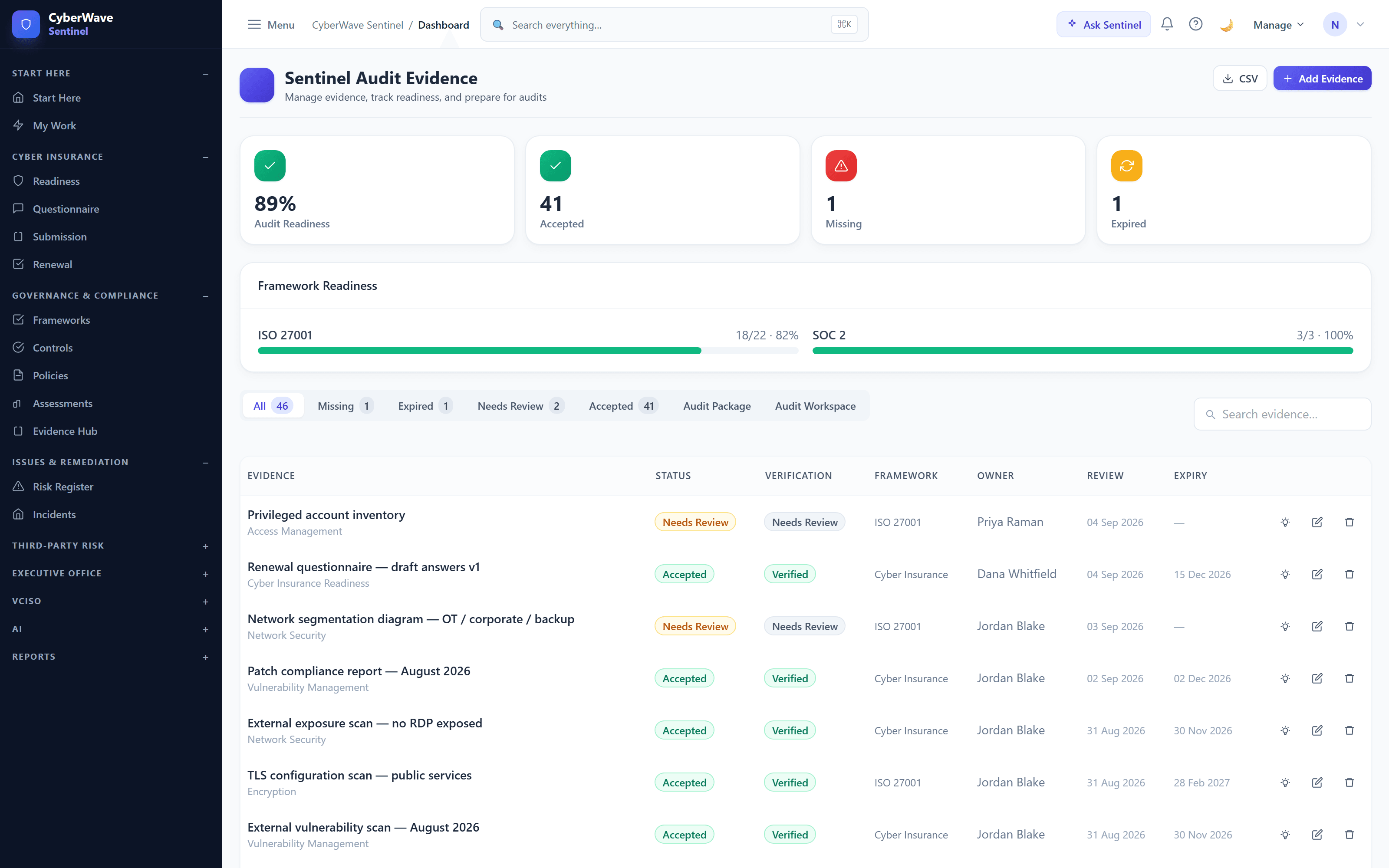
| Example workspace | 80% ready · On Track | 71% ready · In Progress | Available — not yet activated | Available — not yet activated |
| Readiness mapping | ISO 27001 mapping | SOC 2 mapping | NIST CSF mapping | CIS Controls mapping |
- What it is
- A management system standard with Annex A controls. The one most often written into a contract.
- Usually named by
- Enterprise customers and procurement, especially outside North America.
- In Sentinel’s catalogue
- 42 controls
- Example workspace
- 80% ready · On Track
- Readiness mapping
- ISO 27001 mapping
- What it is
- An attestation over trust services criteria, performed by a service auditor.
- Usually named by
- North American SaaS buyers and their security teams.
- In Sentinel’s catalogue
- 45 criteria
- Example workspace
- 71% ready · In Progress
- Readiness mapping
- SOC 2 mapping
Essentials keeps one framework in scope, which is the right shape for a first programme. Full Platform keeps multiple frameworks against the same control set, so a control that satisfies two standards is maintained once and evidenced once. Compare plans
Sentinel supports readiness, governance, assessment, evidence organisation and control management. CyberWave does not certify compliance, issue audit opinions, guarantee compliance, or replace independent auditors, certification bodies or legal counsel. Framework references are informational readiness mappings.
Risk and action
A gap nobody owns is a note, not a finding.
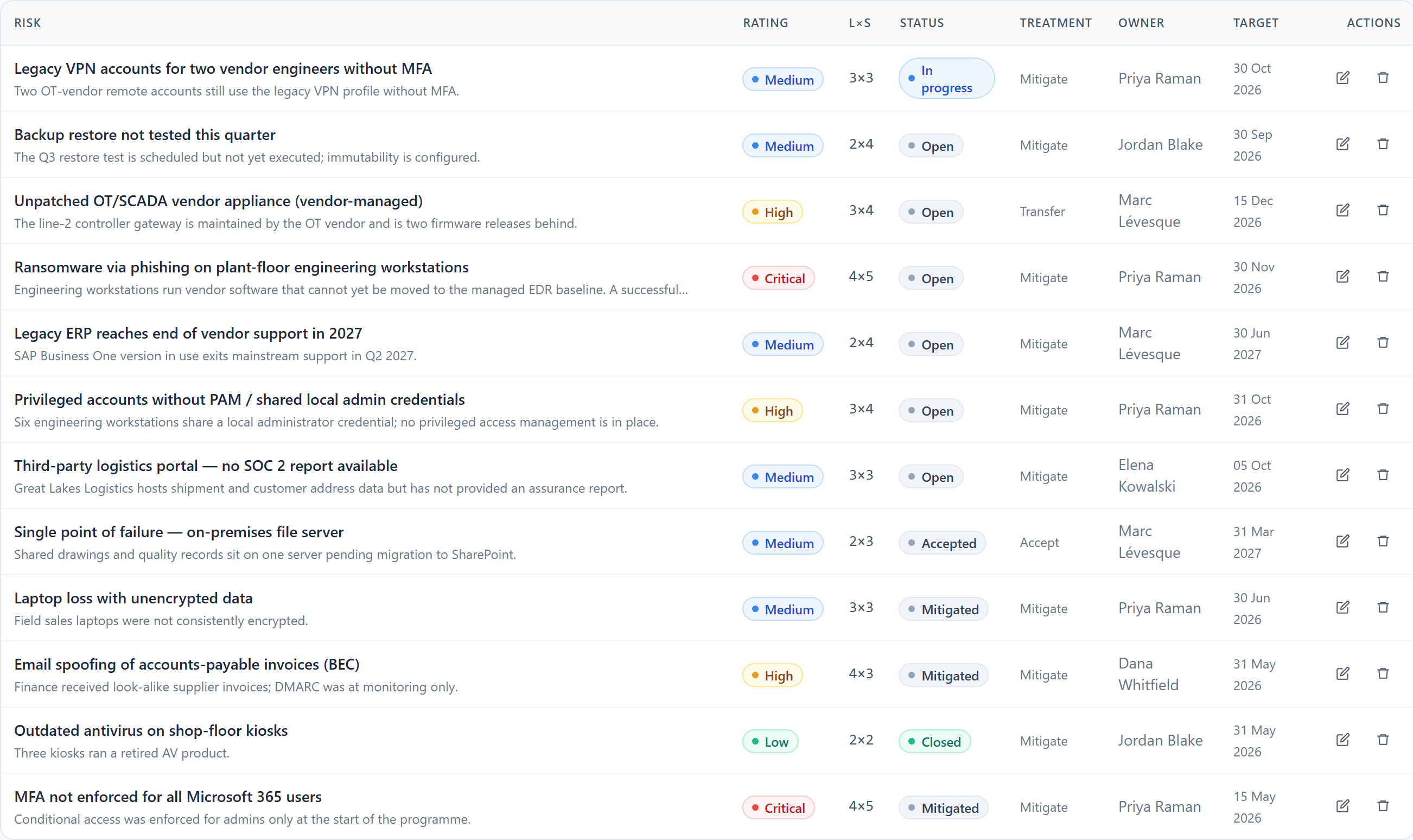
The output of a review is not a percentage. It is a rated risk with a treatment and a target date, and an action with a name and a due date. 12 risks in the example register — 7 open, 1 critical, 2 high — and 13 open actions across the product’s five horizons.
Reporting
Where are we, what changed, what needs a decision.
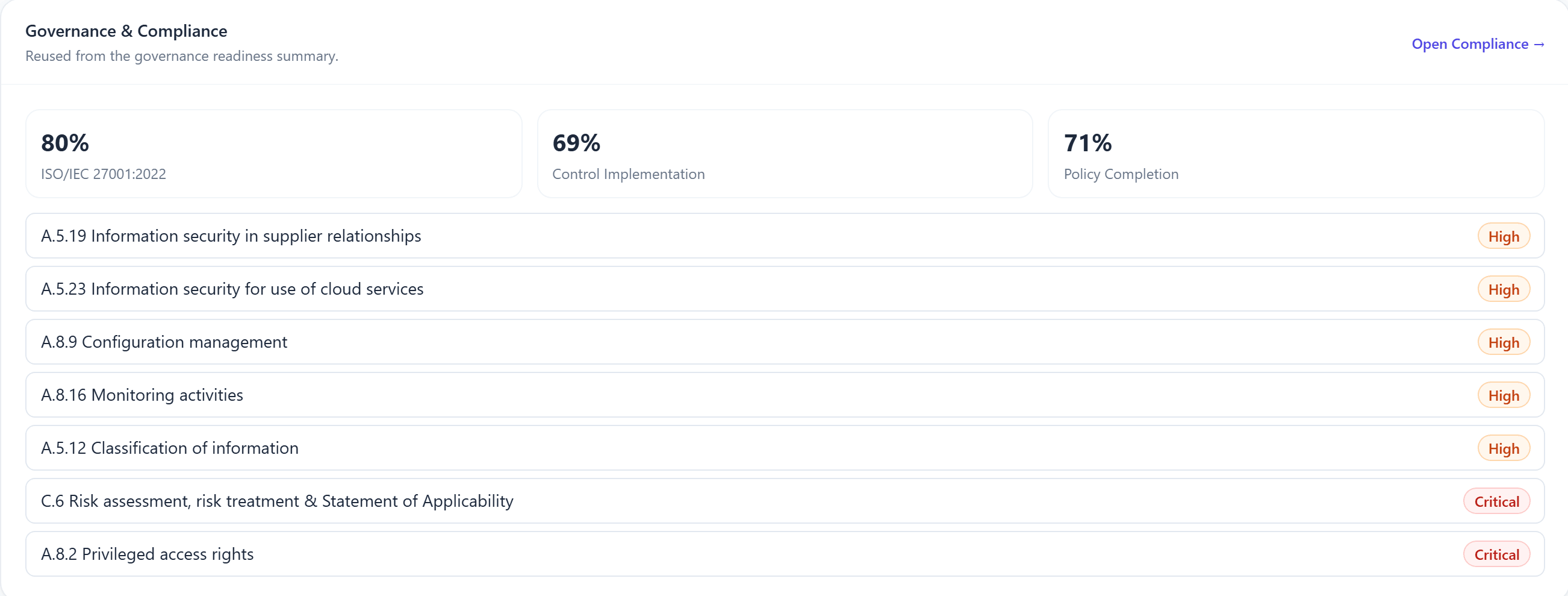
In the example workspace readiness sits in the product’s own “Expected” band, with one critical risk open. The governance summary reads the same register for the executive team: framework readiness, control implementation, policy completion, and the open controls that matter most.
Straight answers
What this does not do.
- No certification, and no audit opinion — those come from an accredited certification body and an independent auditor
- No fabricated baseline: a new workspace reads “Not assessed” until somebody assesses it
- Framework references are readiness mappings, not a conformity assessment
- AI drafts and summarises; it does not decide, and its output is marked for review before it is relied on
Questions
What people ask before they start.
The buying questions, answered plainly.
Which framework should we start with?
Can we run more than one framework at the same time?
Does CyberWave certify us, or issue an audit opinion?
Our auditor works in their own portal. Does that cause a problem?
How long does readiness actually take?
What does it cost to run this?
Start with one framework and one owner.
A scope you can defend, controls with names against them, and evidence that carries a date. Everything else in a compliance programme is downstream of those three things.
No credit card required
- Published pricing on every standard plan
- No credit card required for the trial
- No automatic charge when a trial ends
- Tenant-isolated architecture, data stored in Canada
- Clear data-processing terms
- No compliance guarantee — human judgement still required