Managed vCISO
Someone accountable in the room, without hiring a CISO.
You have a board asking who owns security, an insurer asking who signs off on risk, and a customer asking for a name. A named CyberWave advisor works inside your own Sentinel workspace, on a cadence, and leaves you with decisions that have dates on them.
An engagement starts with a conversation, not a checkout. Only need the platform? Start your 14-day free trial
- Advisory
- $999/mo
- Managed vCISO Lite — published price
- Deeper
- From $2,499/mo
- Managed vCISO — scoped with you
- Advisor seat
- 0 users
- Not one of your Managed vCISO Lite users
Most companies this size do not need a CISO. They need the decisions a CISO would have made.
A fractional advisor is not a discount on a security leader. It is a way to get the decisions made, recorded and dated in a company that will not have a full-time security executive for years — if ever.
Three commitments
One platform, one published advisory subscription, one scoped engagement.
They are not three sizes of the same thing. The first is software your team operates. The second adds a named person on a fixed cadence, which is why it can carry a public price. The third varies with your board cycle, so it is scoped rather than guessed at here.
| Criterion | Full Platform | Managed vCISO Lite | Managed vCISO |
|---|---|---|---|
| What it is | The whole readiness programme — multiple frameworks, audit workspace and board reporting. | Full Platform plus a named CyberWave advisor on a scheduled advisory cadence. | A deeper engagement, scoped to your programme, governance calendar and stakeholders. |
| Who runs the programme | Your team, in the product. | Your team, with a named CyberWave advisor alongside them. | Your team, with deeper advisory hours and support for owning the governance calendar. |
| Cadence | Whatever rhythm you keep. | Scheduled sessions, with the agenda drawn from your register. | Agreed in the statement of work, including board and stakeholder engagement. |
| Price | $249/month · $2,689.20/year | $999/month · $11,388.60/year | From $2,499/month, agreed with the hours |
| Included users | 5 users | 5 users — the advisor is not one of them | Agreed in the statement of work |
| Trial | 14 days, no card | No trial — a cadence cannot be sampled in a fortnight | No trial — scoped first |
| How it starts | Start free trial | Talk to us | Talk to us |
- What it is
- Full Platform plus a named CyberWave advisor on a scheduled advisory cadence.
- Who runs the programme
- Your team, with a named CyberWave advisor alongside them.
- Cadence
- Scheduled sessions, with the agenda drawn from your register.
- Price
- $999/month · $11,388.60/year
- Included users
- 5 users — the advisor is not one of them
- Trial
- No trial — a cadence cannot be sampled in a fortnight
- How it starts
- Talk to us
- What it is
- A deeper engagement, scoped to your programme, governance calendar and stakeholders.
- Who runs the programme
- Your team, with deeper advisory hours and support for owning the governance calendar.
- Cadence
- Agreed in the statement of work, including board and stakeholder engagement.
- Price
- From $2,499/month, agreed with the hours
- Included users
- Agreed in the statement of work
- Trial
- No trial — scoped first
- How it starts
- Talk to us
All figures are USD and the same as the pricing page — there is no advisory rate card that appears only after a call. Essentials at $99/month sits below all three and carries no advisory component. Engagements are governed by the statement of work and the professional services terms.
What the service is
Five things arrive. None of them is a strategy document.
The category’s vocabulary is interchangeable — advisory, guidance, leadership as a service — which is how nobody can tell two offers apart. Here is what is actually delivered, in people, calendars and artefacts.
- 01
A named advisor
One person who learns your environment and stays with it. Not a shared inbox, not whoever is free that week. An insurer, a board and a customer all eventually ask for a name.
- 02
A cadence in the calendar
Sessions booked ahead, not when something goes wrong. The agenda comes out of your workspace: what moved, what expired, what is overdue, what needs a decision.
- 03
Risk decisions, recorded
Your risk register gets worked through with you rather than admired once a year. Accept, fund, defer — each decision gets an owner and a date, in the register, so six months later you can see what was decided and whether it happened.
- 04
Help with the report
The executive page and the board pack, prepared with you rather than delivered to you. You present it; your advisor helps you build it and gets you ready for the questions.
- 05
A governance calendar
Policy reviews, access reviews, evidence that expires, the renewal date, the reporting cycle — laid out for the year so they arrive as scheduled work rather than as a scramble.
How an engagement starts
Scope, baseline, roadmap, cadence.
We write down what is in the engagement and what is not — entities, frameworks, cadence, hours. Your advisor works through what exists and gives you a written position, including the parts that are worse than you expected. The roadmap is sequenced by what is actually due — the renewal, the customer review, the framework a contract named — with an owner and a quarter on each item. Then the sessions start, each one ending with recorded decisions and assigned actions, so the next one opens by checking what moved.
Including the bad week
This is not the incident retainer.
Between sessions the work sits with your control owners, and what your advisor does in between is what the statement of work says it is. If something goes wrong, your incident response provider and your counsel lead it; your advisor helps afterwards, folding what happened into the risk register, the controls and the roadmap. An advisory cadence that has never said what it does in an incident is a service you are buying on trust.
Platform and advisor together
Advice becomes a record, not a recommendation.
An advisor with their own spreadsheet leaves you with two versions of the truth and a handover problem. Yours works in the register your own people maintain, so a decision from a session lands as a row somebody owns. In the example workspace that is 7 open risks with 1 critical, 2 actions critical now, and a cyber-insurance renewal 96 days out — the standing agenda for the next session, drawn from the register rather than from memory.
Readiness moved from 68 to 76 since July. One critical risk is open, and the cyber insurance renewal is 96 days out.
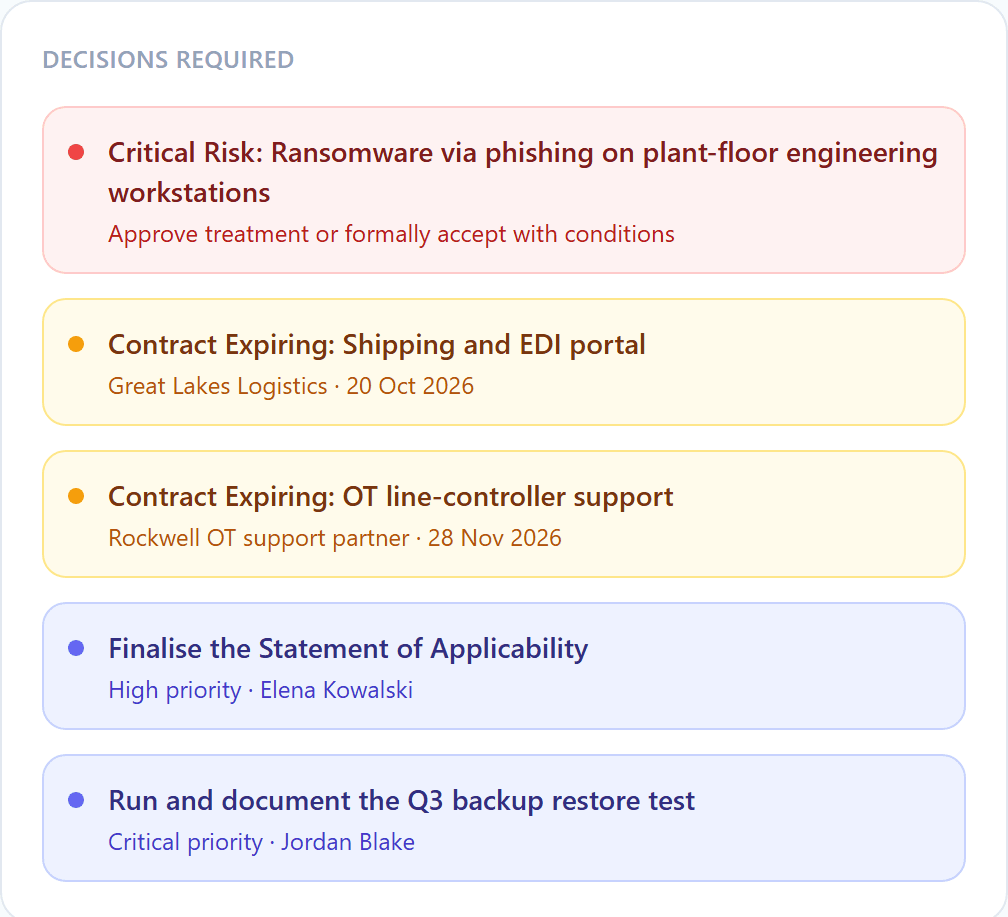
Needs a decision
- Critical risk — ransomware via phishing on plant-floor workstations: approve the treatment or formally accept it with conditions.
- Two contracts expire inside 90 days: the shipping and EDI portal (20 October) and OT line-controller support (28 November).
- Finalise the Statement of Applicability before the Stage 1 readiness review on 20 October.
Screens captured from a Sentinel workspace on 10 September 2026. Northstar Manufacturing Ltd. is a fictional example — a 180-person manufacturer in Ontario, Canada — not a customer, and its scores are computed by the product from its records rather than typed in for the picture.
Straight answers
What Managed vCISO is not.
This belongs on the page rather than in a contract you read after signing.
- A security operations centre. Nobody is watching a screen on your behalf overnight.
- Monitoring, alerting, threat detection, or managed detection and response.
- Emergency incident response. Your incident response provider and your counsel lead that.
- Penetration testing, forensics or dark-web monitoring.
- Legal advice, insurance brokerage, or an audit opinion. Those stay with your counsel, your broker and an independent auditor.
- A transfer of accountability. Your management decides; your advisor makes the position clear and records what was decided.
Scope questions before a conversation: support@cyberwave.ca
Questions
What people ask before scoping an engagement.
Answered here so the conversation can start somewhere more useful than the price list.
What is the difference between Managed vCISO Lite and Managed vCISO?
Does the advisor use one of our user seats?
Is there a free trial on the advisory tiers?
Who is accountable for security decisions during the engagement?
Your management. That is how the service is built, not a disclaimer at the end. Your advisor sets out the position, the options and the consequences, and records what was decided. Accepting a risk, funding remediation, signing a policy and representing your posture to an insurer or a customer stay with you.
What happens if we hire a security leader of our own?
Start with the decisions that are already overdue.
The risk nobody has accepted or funded, the policy nobody has approved, the renewal with no owner. In the example workspace the list starts: “Critical risk — ransomware via phishing on plant-floor workstations: approve the treatment or formally accept it with conditions.” Put a list like that in front of a named advisor on a fixed cadence, and the backlog stops being a personality trait of your company.
A conversation first — the advisory plans have no self-service trial.
- Published pricing on every standard plan
- Tenant-isolated architecture, data stored in Canada
- Clear data-processing terms
- No compliance guarantee — human judgement still required